
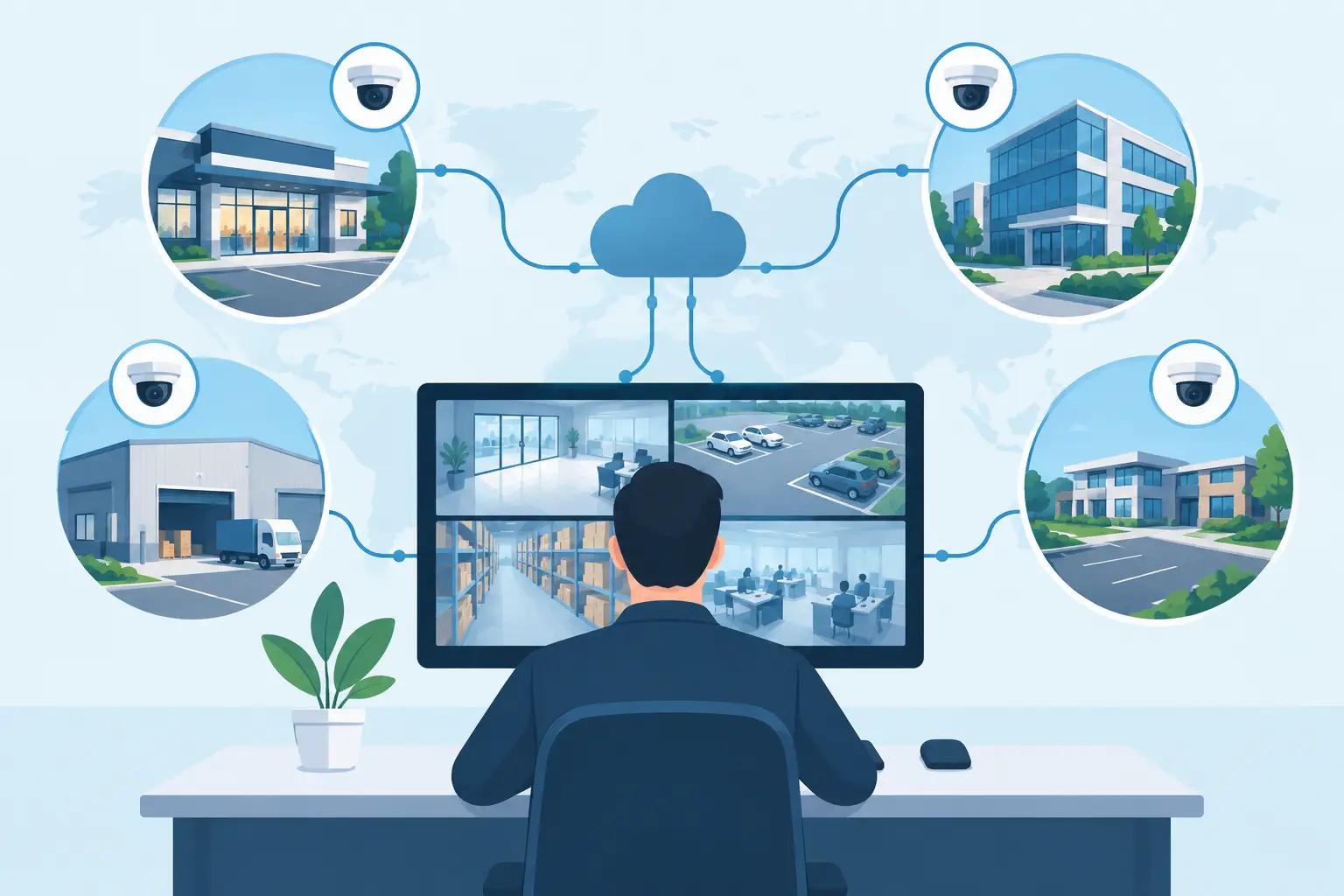
A retail owner in Frisco should not have to open four different camera apps to learn whether a delivery arrived at the warehouse, a back door was left open at the office, or a customer entered a store after closing. Multi location video surveillance management replaces fragmented visibility with one controlled security environment – without treating every property like an identical installation.
For North Texas businesses with two locations or twenty, the objective is not simply to record more video. It is to identify meaningful activity, deter threats at the perimeter, verify incidents quickly, and give authorized decision-makers a dependable view of every site from a smartphone or central workstation.
Why Multiple Sites Create Security Gaps
Each additional property adds more than cameras. It adds staff, vendors, doors, internet connections, alarm events, loading areas, parking lots, and opportunities for inconsistent procedures. A single-location system may work well with a few cameras and a local recorder. Scale that approach across several sites, and owners often inherit mismatched equipment, weak passwords, unreliable remote access, and hours of unusable footage.
Passive cameras create another problem. Traditional systems often tell you what happened after a theft, break-in, or liability event. That has value, but it is not total property protection. A more effective architecture uses cameras that analyze activity at the edge, distinguish people and vehicles from irrelevant motion, and trigger a defined response before someone reaches the building.
That response may include an immediate mobile alert, a virtual tripwire notification, activated lights, an audible warning, or live video delivered to professional monitoring agents. The right action depends on the site, the time of day, and the nature of the activity. A person walking near a storefront during business hours is different from someone entering a fenced service yard at 2:00 a.m.
What Multi Location Video Surveillance Management Should Deliver
Centralization is not just a matter of putting all camera feeds on one screen. It means applying consistent security rules while preserving each location’s operational needs. An office, warehouse, medical practice, and retail site require different camera placement, retention priorities, and access permissions.
A well-designed system gives an owner or regional manager a unified view of live and recorded video, alerts organized by location, and fast search tools for people, vehicles, or specific zones. Instead of reviewing six hours of parking-lot footage, a manager can investigate an AI-filtered event tied to a virtual boundary or after-hours schedule.
The platform should also establish clear user roles. A store manager may need access to that store’s customer entrance, cash-wrap area, and receiving door. A facilities director may need visibility across all properties. A third-party vendor should not receive unrestricted access to security footage merely because they need to service one building.
Central oversight without constant monitoring
No business owner has time to watch live feeds all day. The purpose of video intelligence is to make exceptions visible. AI-powered detection filters out common sources of false alerts, such as changing shadows, rain, trees, or ordinary vehicle movement outside a defined area.
This does not mean every alert is automatically a crime. Camera analytics require proper installation, careful zone design, and periodic adjustment. A poorly aimed camera or overly broad detection zone can still generate noise. The advantage of a custom system is that the technology is configured around the property rather than forced into a generic template.
Faster decisions during real events
When an intrusion alarm activates, a conventional system may report only that a sensor was tripped. Video verification adds context. Authorized users or professional monitoring agents can see whether a person is present, where they are moving, and whether a response is needed.
For qualifying events, live verified video can support faster, more informed emergency dispatch. It also helps reduce the costly cycle of false alarms, unnecessary dispatches, and employee call trees. Cameras become part of the response process, not just an archive for later review.
Build the System Around the Property, Not the Camera Count
Reliable multi location video surveillance management begins with an onsite assessment. The question is not, “How many cameras do we need?” The question is, “What must this business be able to see, verify, deter, and control at each location?”
At a retail site, priority areas may include entrances, point-of-sale zones, stockrooms, receiving doors, and parking areas. A warehouse may require wide-area yard coverage, dock doors, equipment storage, and controlled employee entrances. Professional offices often need protected reception areas, exterior approaches, network closets, and after-hours access points.
Camera type matters as much as placement. Wide-angle cameras can cover broad interior spaces, while varifocal or dedicated identification cameras may be needed at gates, doors, and drive lanes. Low-light performance, infrared coverage, weather protection, and mounting height all affect whether footage is actually useful when an incident occurs.
The network deserves the same engineering attention. High-resolution video places real demands on switches, wireless links, power, storage, and internet connectivity. Consumer-grade networking can cause dropped cameras, delayed playback, and weak remote access precisely when the system is needed. Enterprise-grade network infrastructure provides the foundation for dependable video, access control, automation, and remote management.
Connect Video to Access Control and Deterrence
The strongest multi-site security systems do not operate as isolated tools. Video should work with intrusion detection, smart access control, and active deterrence to create a coordinated response.
Consider a delivery entrance at a multi-location business. Cloud-managed credentials can show who is authorized to enter, when they entered, and which door they used. The associated camera provides visual confirmation. If the door is forced open after hours, the system can record the event, send an alert, activate deterrence devices, and route live video for verification.
This integration also reduces physical-key vulnerabilities. When an employee leaves, a credential can be revoked without collecting keys or changing locks. When a contractor needs temporary access, permissions can be limited by door, date, and time. Video provides accountability without requiring managers to stand at every location.
There are trade-offs. More integration requires thoughtful programming and a stable network. It is not the right approach to add every possible automation rule simply because the platform supports it. The best design uses technology where it reduces response time, improves accountability, or strengthens protection.
A Practical Operating Model for Multi-Site Owners
Once the system is installed, daily management should be straightforward. Owners and regional leaders need a short list of meaningful alerts, quick access to live views, and confidence that each location remains online. Local managers need only the permissions and notifications relevant to their responsibilities.
Regular operational reviews help keep the system effective. Check for cameras blocked by new signage or landscaping, verify that critical views remain clear, confirm retention periods, and update user permissions as staff changes. Review alert activity as well. Repeated false notifications usually signal a configuration issue worth correcting, not something employees should learn to ignore.
For growing businesses, standardize the security design principles rather than blindly duplicating equipment. A consistent approach to naming cameras, organizing locations, assigning user roles, and defining alarm responses makes expansion easier. Yet each new site should still receive an assessment because its building layout, exposure, and operations may be different.
NDX Security designs multi-site systems as an engineered protection strategy, combining AI-driven video intelligence, verified monitoring, access control, and the network infrastructure needed to keep them dependable. The goal is local service accountability with the visibility and control expected from enterprise-grade security.
A camera system earns its value when it helps the right person make the right decision quickly. For every new location, start by defining the events that matter most – then build the visibility, deterrence, and response plan around them.