
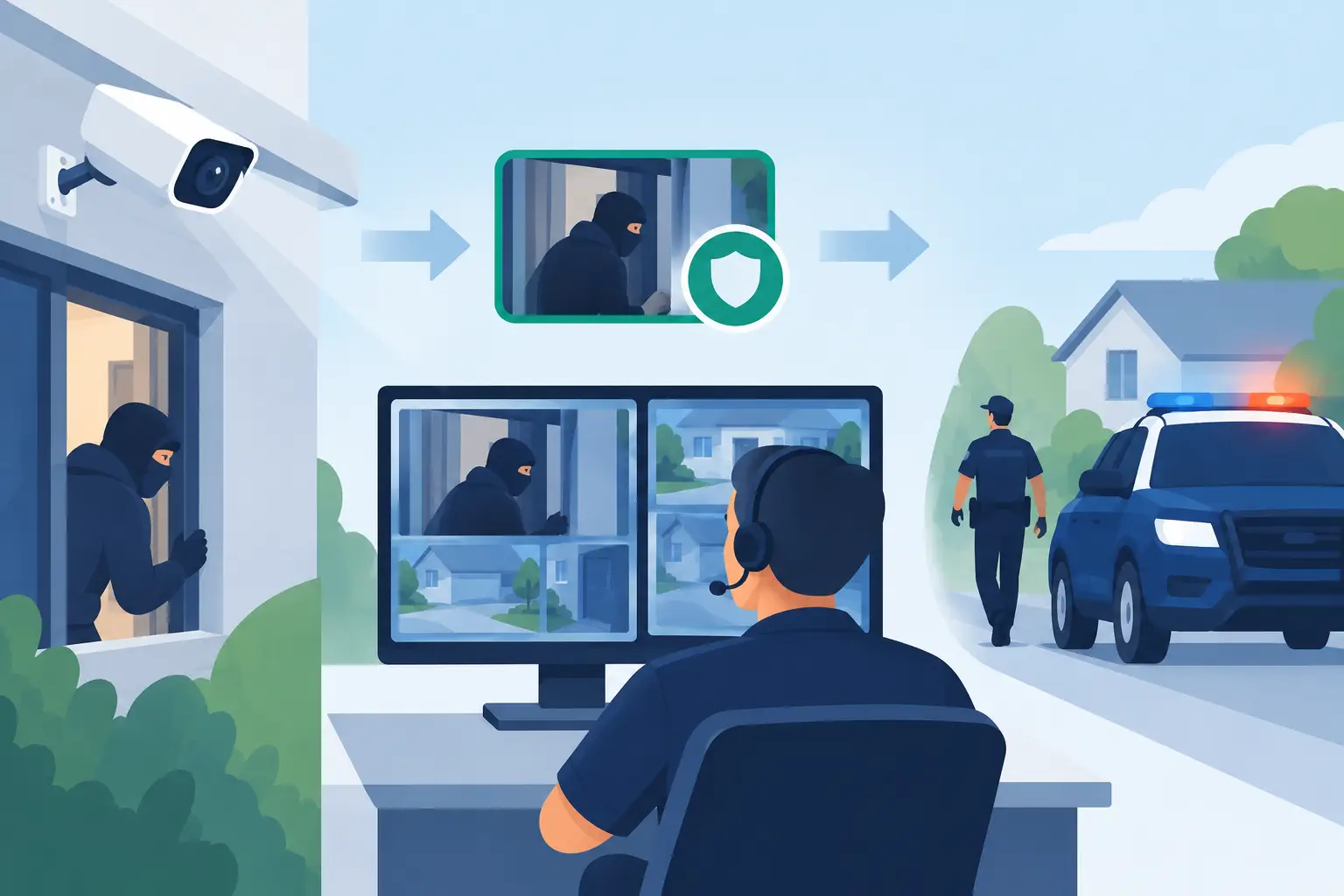
A glass-break sensor or door contact can tell a monitoring center that something happened. It cannot tell them whether a family member came home early, a delivery driver approached the wrong entrance, or an intruder is moving through the property. Video verified alarm monitoring closes that gap by giving trained monitoring agents live visual context at the moment an alarm is triggered.
For North Texas homes and small businesses, that difference is operationally significant. A conventional alarm is built to react after a point of entry is breached. A properly engineered verified video system can identify a threat at the edge of the property, deter it before entry, and give emergency responders more useful information when intervention is necessary.
What Video Verified Alarm Monitoring Actually Does
Video verified alarm monitoring combines intrusion detection, AI-powered cameras, and professional monitoring into one coordinated response. When an event occurs, the system does more than send a generic alarm signal. It presents live or recorded video evidence to monitoring professionals who can evaluate the situation and follow an appropriate response protocol.
The sequence begins with detection. A door contact, motion detector, glass-break sensor, virtual tripwire, or AI camera analytic identifies activity that meets the system’s programmed criteria. Rather than treating every moving object as a threat, modern edge AI can distinguish people and vehicles from common sources of nuisance activity such as wind, pets, headlights, or tree movement.
When an event is credible, the system can activate deterrence at the property. This may include strobe lights, audible warnings, automated lighting, or a voice-down message directed at the person on site. At the same time, professional agents receive the alarm event with the associated video. They can verify whether an actual emergency is unfolding, contact the property owner according to the response plan, and request emergency dispatch when warranted.
That visual confirmation changes the quality of the alarm. Instead of reporting only that a sensor activated, a monitoring center can communicate relevant details such as a person entering through a side gate, a vehicle lingering near a loading area, or visible movement inside a protected building.
Why Conventional Alarms Leave Critical Gaps
Traditional alarm systems still have a role. Door contacts, glass-break detectors, panic buttons, and interior motion sensors remain essential layers of physical protection. The limitation is that they are usually blind. They notify a monitoring center only after a device changes state, often after a person has already crossed a boundary or entered the structure.
Passive security cameras have a different limitation. They may capture useful footage, but footage reviewed after a theft is evidence, not active protection. A camera that records a crime without notifying anyone in time to act does not provide the same value as a monitored system designed to identify and interrupt suspicious activity.
False alarms create another problem. Repeated sensor-only alarms can lead to unnecessary calls, costly local false-alarm penalties, disrupted operations, and hesitation when a real event occurs. Video context helps monitoring agents separate an actual security incident from a harmless trigger. It does not eliminate every false alarm, because no security technology can promise that, but it gives response decisions a far stronger factual basis.
For property owners, the practical benefit is control. You can see what occurred, understand why a response was initiated, and avoid relying on assumptions when your home, office, warehouse, or retail location is at risk.
How a Verified Response Works at the Property Edge
The strongest systems are designed around the places where risk begins, not just around the doors and windows. For a residence, that may mean a driveway approach, side yard, pool gate, rear fence line, detached garage, or package delivery area. For a business, it may mean employee entrances, loading bays, equipment yards, dumpster enclosures, rear doors, and after-hours parking areas.
Cameras positioned at those locations use analytics and virtual tripwires to recognize activity crossing a defined boundary. Rules can be tailored by schedule, direction of travel, zone, and object type. For example, a vehicle entering a business parking lot at 2:00 p.m. may be normal. A person walking behind the building at 2:00 a.m. may require immediate attention.
When the rule is triggered, the system can respond in stages. It may first record the event and notify the owner. If the activity escalates or meets an alarm condition, it can activate lights and audible deterrents while sending video to the monitoring center. This layered approach is more intelligent than sounding an alarm every time a camera sees movement.
The right response depends on the site. A family home needs protection without creating constant alerts from children, pets, and guests. A warehouse may prioritize perimeter detection and employee-access events. A retail business may need controlled entry, monitored back doors, and visibility into multiple locations from one smartphone application.
Faster Dispatch Starts With Better Information
Emergency dispatch is most effective when responders receive actionable information. Video verification gives monitoring agents the ability to describe a visible threat rather than report an unconfirmed sensor signal alone. That can help establish the urgency and nature of the event.
Response policies and dispatch practices vary by municipality, monitoring provider, and event type. Video verification does not guarantee a specific police response time, and it should never replace calling 911 when someone is in immediate danger. It does, however, reduce ambiguity during a critical event and can support a more informed emergency response.
The deterrence stage is equally valuable. Many intrusion attempts are opportunistic. A visible camera, sudden exterior lighting, strobe activation, or a clear voice warning can make the property a less attractive target before damage or entry occurs. The goal is not merely to document loss. It is to disrupt the threat early.
Design and Network Quality Determine Performance
Video verified alarm monitoring is not a box that can be placed on a wall and expected to work perfectly. Camera angles, lighting conditions, network capacity, Wi-Fi coverage, cellular backup, power protection, device placement, and alarm programming all influence reliability.
A camera aimed too high may miss identifying detail. A camera aimed directly into headlights may generate poor nighttime images. Weak Wi-Fi at a detached garage can delay video delivery. An overloaded network can affect viewing and event uploads. These are engineering issues, which is why a site assessment matters before equipment selection.
A custom design should also account for privacy. Cameras should protect the property without unnecessarily capturing private neighboring areas. User permissions should be defined so household members, managers, employees, or vendors receive only the access they need. For commercial sites, cloud-managed credentials can tie door access events to video, making it easier to investigate an after-hours entry or resolve an operational question.
NDX Security designs the intrusion, video, automation, and network layers as one system rather than assembling disconnected devices. That approach supports dependable remote management and helps ensure that alerts, deterrence, and professional monitoring work together under real-world conditions.
Who Benefits Most From Verified Monitoring
Verified video monitoring is especially valuable for properties where response time, asset value, or repeated nuisance alerts are concerns. Homeowners may use it to protect secluded lots, secondary structures, high-value vehicles, and family access points. It can also provide confidence while traveling, allowing owners to review events and manage their system remotely.
Small businesses benefit when the system supports both security and daily operations. A business owner can receive alerts for a rear-door opening after closing, confirm whether a delivery arrived, review an access event, or investigate activity around inventory and equipment. Multi-location operators can apply consistent rules while retaining local visibility over each site.
Still, not every property needs the same level of intervention. A compact home with a clear front entry may need fewer cameras and simpler rules than a large estate with multiple perimeter zones. A low-traffic office may require a different design than a busy retail store. The right system is the one that covers meaningful risk without overwhelming the owner with notifications.
Start With the Threats You Want to Stop
The best first step is to identify where unauthorized access could occur, what assets need protection, when the property is most vulnerable, and who needs authority to view or control the system. From there, a security professional can map detection zones, select appropriate camera locations, establish monitoring rules, and build a response plan that fits the way the property is actually used.
A well-designed verified video system should feel quiet when life is normal and decisive when it is not. Before choosing an alarm provider, ask whether the proposed design can show what happened, deter a threat at the perimeter, and give trained professionals the information they need to act with confidence.