
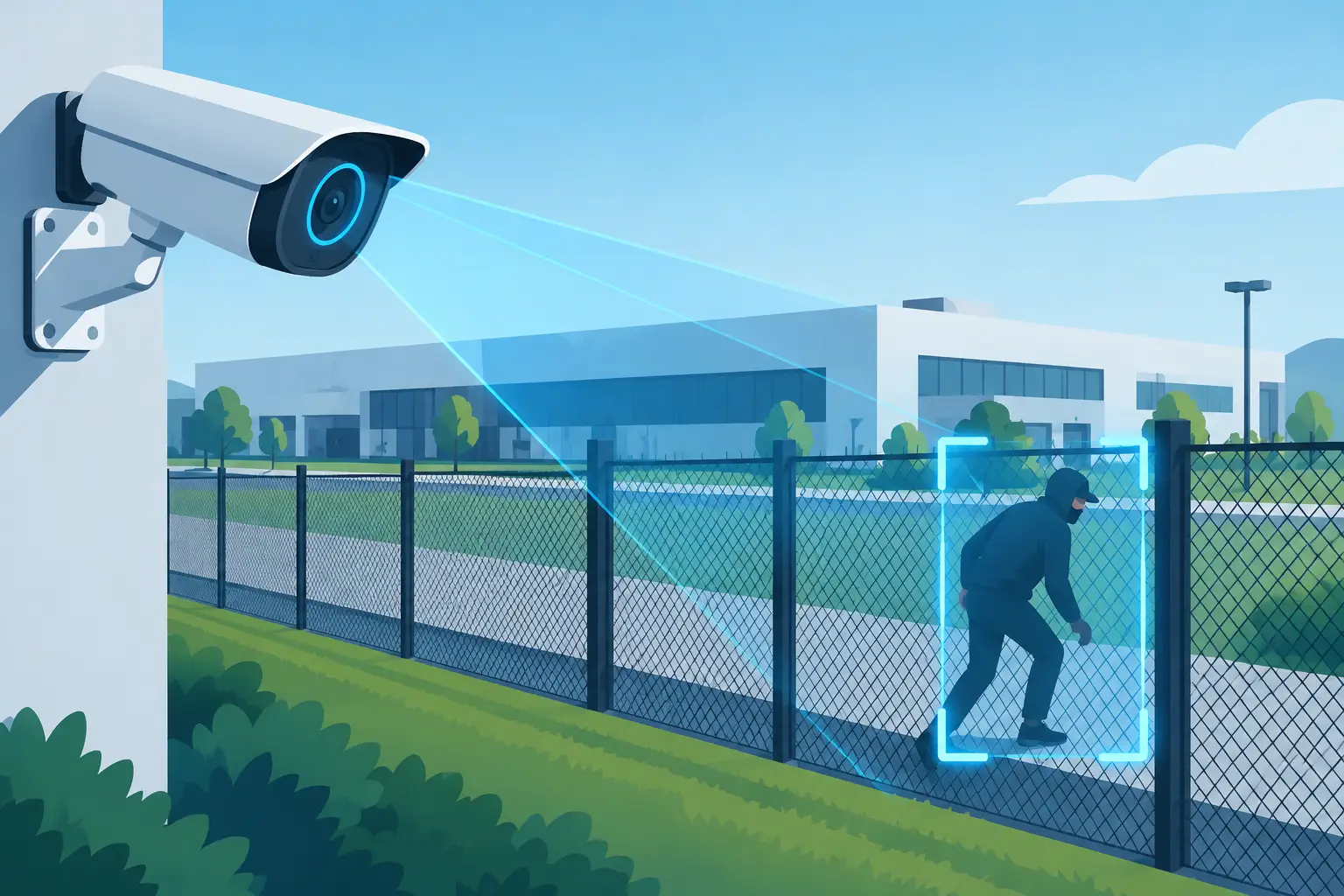
A driveway camera that records a stranger after they reach the front door is evidence. AI perimeter security cameras are designed to be protection. They analyze activity at the property edge – before an individual reaches an entry point, parked vehicle, loading area, or vulnerable side gate – so the system can distinguish a meaningful threat from ordinary motion and initiate a response.
For North Texas homeowners and small businesses, that difference matters. Conventional alarm systems often wait for a door or window to open. Basic cameras may capture hours of motion clips caused by shadows, insects, rain, and passing traffic. A properly engineered AI video system creates earlier awareness, fewer nuisance alerts, and a path to active deterrence when someone should not be on the property.
What AI Perimeter Security Cameras Actually Do
The term AI is used loosely in the security market, so it helps to be specific. In a quality perimeter security system, artificial intelligence runs on the camera or video platform to classify objects and evaluate behavior. Instead of treating every pixel change as motion, the system can identify people, vehicles, and, depending on the platform, other object types.
That classification is the foundation for useful alerts. A homeowner does not need a notification every time tree branches move across the backyard. A warehouse manager does not need an overnight alert each time headlights sweep across a distant street. The system can be configured to alert when a person crosses a virtual tripwire near the side gate, when a vehicle enters a restricted drive lane after hours, or when someone lingers near a delivery door.
AI does not make a camera infallible. Low light, poor camera placement, heavy weather, and an obstructed view can affect performance. That is why the camera itself is only one component of an effective design. Lens selection, mounting height, illumination, network reliability, recording capacity, and alert rules all determine whether the intelligence delivers a dependable outcome.
Protection Begins at the Property Edge
A reactive alarm has value, particularly when professionally monitored. But by the time a contact sensor is tripped, an intruder may already be inside or attempting entry. Perimeter detection moves the decision point outward.
For a residence, that could mean monitoring the approach to a detached garage, side yard, rear gate, pool area, or long driveway. For a small business, it may mean protecting employee entrances, fenced equipment yards, dumpsters, loading bays, storage areas, and vehicle lots. The goal is not to alert on every person who approaches a visible storefront or walks down a public sidewalk. The goal is to define the locations and times where presence becomes suspicious.
This is where virtual tripwires and intrusion zones are more valuable than generic motion alerts. A virtual tripwire can be placed across a gate opening or driveway. An intrusion zone can cover a specific section of the property while excluding the street, neighboring driveway, or moving landscaping. Time schedules add another layer of control, allowing different rules during business hours, overnight, weekends, or while a family is away.
When the rules are designed around how a property actually operates, alerts become actionable rather than exhausting.
From Detection to Active Deterrence
Detection is useful. Deterrence is better.
An AI event can trigger actions that make an intruder reconsider before damage or entry occurs. Depending on the system design, that may include exterior lighting, a strobe, an audible warning, a speaker message, a push notification, or an alert to a professional monitoring center for live video verification.
A visible response changes the encounter. Someone attempting to test doors at a closed office may be met with light, sound, and the knowledge that their activity has been identified. A person entering a residential side yard may receive a warning before reaching the home. These responses should be deliberate, not indiscriminate. A loud warning at a front walk may be appropriate after midnight but unacceptable during normal daytime deliveries.
Professional monitoring adds another layer when configured with live video verification. Monitoring agents can assess an alarm event through designated cameras, follow documented response procedures, and communicate verified information to emergency responders when warranted. This can support a faster, better-informed dispatch than an unverified alarm signal alone. It also means the property owner is not solely responsible for interpreting an alert at 2:00 a.m.
No camera system can guarantee that law enforcement will respond within a certain time or prevent every crime. Its purpose is to reduce opportunity, accelerate awareness, preserve clear evidence, and create an organized response when an event occurs.
Why False Alerts Are a Design Problem
False alarms undermine security. They train people to ignore notifications, disrupt operations, and can lead to unnecessary dispatches. AI classification helps reduce this problem, but it is not a substitute for careful system engineering.
A camera aimed too broadly may include a busy street. A view blocked by decorative trees can create unreliable detection. A camera mounted too high may recognize a person but fail to capture a useful face image. A camera mounted too low may be easily tampered with. At night, bright backlighting can turn a subject into a silhouette, while inadequate lighting can limit identification at the moment it matters.
The right approach begins with a property assessment. The designer should identify likely approach paths, vulnerable assets, normal traffic patterns, available mounting locations, lighting conditions, and network requirements. From there, each camera can be assigned a job: detect a person approaching, identify a face at an entrance, observe activity across a yard, or document vehicles entering and leaving.
One wide-angle camera rarely performs every job well. Coverage maps often look impressive on paper while leaving gaps in identification and detection. Custom camera placement creates stronger results with less noise.
Residential Uses: Security Without Constant Surveillance Fatigue
Homeowners often want awareness without turning daily life into a stream of alerts. AI rules make that possible when they reflect how the household lives.
A family may want person detection at the rear gate and garage after dark, but not alerts every time children use the backyard. A long-driveway property may need vehicle detection at the entrance with a notification only after a vehicle crosses deeper into the property. A vacation setting may call for stricter perimeter rules while still allowing trusted housekeepers, pet sitters, or family members to enter through managed access credentials.
AI video also works well with connected-home automation. Exterior lights can illuminate when a person enters a designated zone. A homeowner can view live video from a smartphone, confirm a visitor, and remotely manage access without distributing physical keys. The security system remains useful because it is integrated into the way the home is used, not treated as a separate piece of equipment that is armed and forgotten.
Privacy should be part of the plan. Cameras should be directed at your property and legitimate access points, not into neighboring private spaces. Appropriate user permissions, strong passwords, protected network infrastructure, and thoughtful retention settings are equally important. A smart camera on an insecure network is not engineered security.
Small-Business Uses: Visibility That Supports Operations
For small businesses, perimeter video is not only about catching a break-in. It provides operational visibility at the places where risk and access intersect.
A retail owner can receive an after-hours person alert at a rear door. An office can monitor deliveries and vendor access at a service entrance. A warehouse can establish virtual tripwires around trailers, inventory, and fenced equipment. A multi-location operator can view standardized alerts across sites from one smartphone-based platform rather than relying on separate cameras, keys, and alarm codes at every facility.
Access control strengthens the model. When doors use managed credentials instead of unmanaged physical keys, administrators can issue, modify, and revoke access without rekeying the building. Video tied to entry events provides context: who used a door, when it opened, and what occurred around that access point. This is particularly valuable for employee entrances, restricted storage, and contractor access.
The trade-off is that advanced systems require a dependable foundation. Cameras, access control panels, network switches, Wi-Fi where needed, power protection, and recording hardware must be selected and installed for the site. Low-cost equipment may look comparable in a product listing, but it often produces unreliable notifications, poor night images, weak network performance, and limited support when a failure occurs.
Choosing the Right System for the Property
The right camera count is not determined by square footage alone. A compact office with a rear alley, two entrances, and expensive equipment may need more purposeful coverage than a larger open facility. Likewise, a home on a corner lot has different exposure than a home on a gated cul-de-sac.
During a professional assessment, ask how the system handles person and vehicle classification, where footage is recorded, how long it is retained, what happens if internet service fails, and who can access the system. Ask whether cameras can activate deterrence devices, how monitoring agents receive video, and whether the equipment remains yours. Those answers reveal whether the proposal is a packaged camera sale or a complete protection strategy.
NDX Security designs systems around those details: property layout, daily routines, critical assets, network conditions, and the response required when a real event occurs. The objective is total property protection with practical control, not a collection of devices that create more alerts than answers.
The best time to define the perimeter is before someone tests it. A well-designed AI camera system gives your property a chance to recognize the threat early, respond with purpose, and keep control where it belongs – with you.